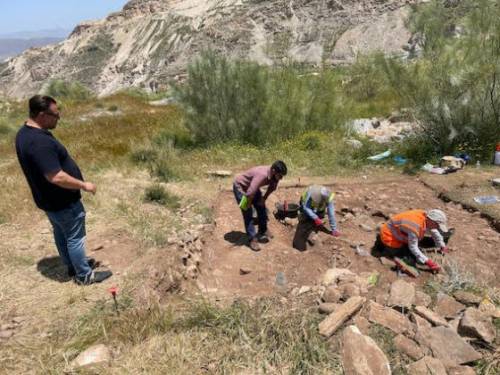
The fifth excavation campaign at the archaeological site of Macael Viejo began at the beginning of May. On this occasion, the work is focused on an area of the settlement where in previous years the presence of a low medieval necropolis with alteration of an earlier prehistoric funerary space had been found.
In order to obtain information about the settlers who occupied Macael Viejo, a small depression has been chosen in the area occupied by the necropolis where it is hoped to find a funerary context less altered by the looting and later use of the land due to the greater clogging of the ground. A test excavation has been carried out here, covering part of a road that was built in the mid-1980s and which would have sealed the remains in a period when the marble of the site was being heavily exploited, and another, larger one that includes a cultivated terrace under which it is hoped to reach the level of the necropolis in good conditions of preservation.
The work carried out so far has brought to light several burial sites that follow the Islamic burial rite and which show that the settlers maintained great order and respect when it came to positioning their dead. All the graves are perfectly oriented and their appearance in both test pits, as well as in those carried out in previous campaigns, shows that we are in front of a cemetery of considerable dimensions which shows that Macael Viejo had a high level of occupation in the late medieval period.

During the excavation, numerous Neolithic ceramics altered by the medieval phase have also been recovered, as well as various Chalcolithic tools both on the surface and in the dragged levels. This campaign has placed emphasis on the location of white marble stelae that originally marked the location of the wealthiest tombs and which, having been reused for the construction of cultivation platforms and cairns, are scattered around the hill. To date, two of them have been recovered, which, due to their technical quality and decoration, are of great interest for the study of the funerary and productive context of the site.